

I just tested the Oppo Find X9 Ultra against the Honor 600 Pro, and a lot of you asked for the Magic8 Pro instead. Fair enough. So this time the big brother steps up, and the price gap makes it interesting: the Find X9 Ultra sits at around €1,500 here in Germany, while the Magic8 Pro is already available for under €1,000.
As in my last test, I shot all three of Honor’s photo styles so you can see what each one does. Vibrant is the default, natural pulls things back, and authentic consistently boosts saturation and contrast rather than delivering the true-to-life look the name suggests.
Daylight
Starting with the ultra wide, Honor’s vibrant mode lands close to the Oppo, while natural shifts to a colder tone and authentic visibly stands out from the group. On the main lens the Oppo stays more true to life, though the Magic8 Pro still delivers solid results.
Move to the telephoto and the Oppo produces the more appealing image, mainly because the Honor applies much heavier processing. The Find X9 Ultra benefits from its dedicated 10x optical lens, which gives it the overall edge, but the Honor holds its own and the AI enhancer closes the gap further than I expected.
At 30x the Oppo takes a clear lead, with Honor’s AI enhanced shot tidying things up only slightly. If you want to push to the absolute limit, the Oppo reaches 120x and the Honor caps at 100x with very aggressive processing.
In the second scene the vibrant colours from both phones look nearly identical. Honor’s natural style dials things back significantly here and actually delivers the most realistic ultra wide shot of the group, while authentic goes heavy again. On the main lens the Oppo opts for a more subdued approach and the Honor stays vivid, to the point where its natural style feels almost muted by comparison.
At 2x the Oppo holds a minor edge in image quality alongside slightly less saturated colours, and that carries over to the telephoto. Honor’s vibrant shot is visibly brighter, switching to natural feels like someone dimmed the lights, and authentic overprocesses the scene once more.
At 10x Honor’s vibrant colours closely match the Oppo, but the Find X9 Ultra wins on pure detail thanks to that optical lens.
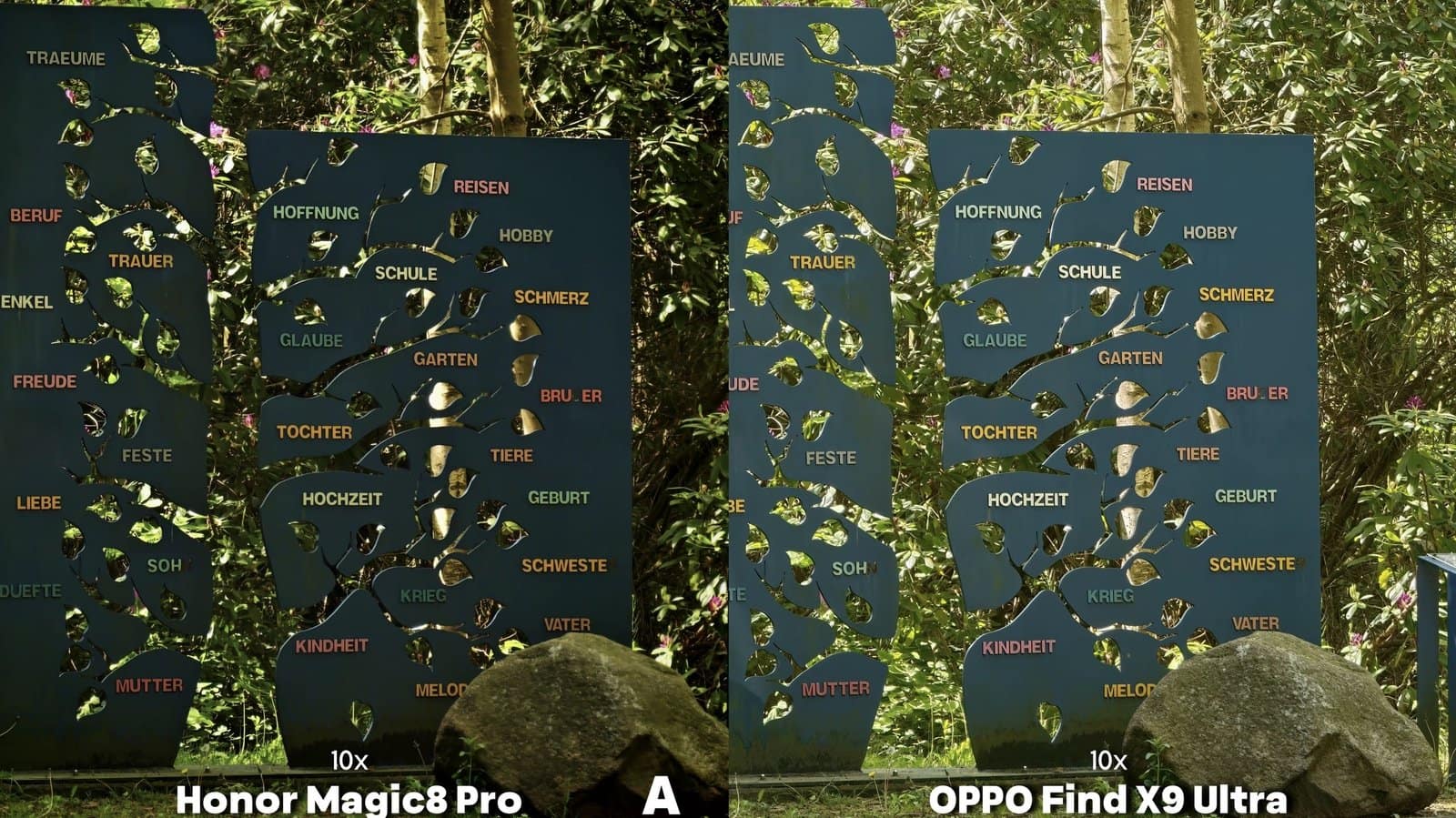
Interestingly, natural is the brighter option at this range while authentic darkens the image and pumps up saturation as usual.
In the third scene, on a bright sunny day, Honor’s natural style struggles to balance the exposure and the result looks washed out. One point for the Honor: its ultra wide has a slightly wider field of view, though it isn’t a big difference. The Oppo’s main lens leads on image quality and stays ahead at 2x. On the telephoto, natural comes closest to Oppo’s colour rendering, which then flips at the next range where vibrant becomes the closest match and natural looks off.
Macro
I put Oppo’s main lens in macro mode against Honor’s dedicated super macro. The Magic8 Pro lets you get physically much closer to the subject, which is genuinely useful. But you can also just punch in with Oppo’s 10x telephoto, and looking at the flowers, the Oppo delivers far superior image quality. The same holds comparing Oppo’s 10x directly against Honor’s 2x super macro.

So the Honor gets you closer. The Oppo gets you the better photo.
Portraits
Two completely different approaches here. The Honor produces significantly punchier colours, the Oppo goes for a more natural look while struggling a bit with exposure balance.
At 2x the Find X9 Ultra pulls ahead on sharpness and detail. On the telephoto Honor’s colour science moves closer to the Oppo, but the overall picture quality is a bit disappointing at that range.
Then it flips. Comparing 5.9x on the Honor to 6x on the Oppo, I actually prefer the Magic8 Pro. Better quality, better background separation, even if the colours stay slightly too vivid. At 10x the Oppo gets the expected quality boost, but the Honor does a noticeably cleaner job separating the background around my beard.
Selfies
Both default to 0.8x on the front camera. Colour accuracy is the main differentiator again, with the Magic8 Pro looking slightly off. Punch into 1x and you can see the Honor applies a subtle background blur even in standard mode.
With portrait mode active, the Honor applies a much stronger blur and finer edge separation, but the Oppo simply delivers better image quality. The Find X9 Ultra is also the only one that lets you shoot at 0.8x with bokeh enabled, where the Honor forces you to 1x. The Oppo takes this round clearly.
Low light
Starting with the ultra wide, neither shot is amazing, but the Oppo keeps noise levels lower. Both improve drastically on the main lens, where the Oppo produces the brighter image. That advantage holds at 2x with finer detail and less grain, and the telephoto continues to dominate. At 10x the optical zoom has the upper hand, though the gap isn’t as big as you might expect. Push to 30x and the difference becomes extremely noticeable.
The next scene flips it. Zooming in on the green lit windows up top, Honor’s version looks slightly better, and on the main lens the Honor takes a massive lead in brightness. It’s also undeniably much brighter than the scene actually looked in reality, which is the recurring theme with this phone.
Both drop in quality at 2x and recover with their telephoto lenses. At 10x the Oppo is visibly better but the Honor holds up surprisingly well. At 30x it’s a clear win for the Find X9 Ultra again.
What night mode actually does
This is the part worth knowing about, because the two phones treat night mode completely differently.
On the Honor, night mode instantly brightens the scene. On the Oppo it looks virtually identical to the auto shot. Switching to the main lenses, the auto images look very similar apart from how the pavement renders, and turning night mode on still makes no significant difference on either device, though the Oppo gets slightly warmer.
Both struggle at 2x and night mode doesn’t recover the detail. Oppo’s telephoto gives the better shot and keeps that lead at 10x, where the Honor still performs admirably.
The one major exception: Honor’s 30x shot already looks rough in auto, and turning night mode on restricts you to a maximum of 15x zoom. The Oppo produces solid images in both modes and lets you go to 120x regardless.

At the last location the pattern repeats. Honor’s ultra wide is much brighter, both get a slight boost from night mode, and the brightening effect is far more drastic on the Honor with the main lens. By 2x it isn’t a factor anymore and the Oppo performs better anyway. On the telephoto the Honor is noticeably noisier and night mode doesn’t clean it up. At 10x the two are practically identical.
Low light portraits and selfies
The Oppo takes the win for keeping skin tones and lighting much more true to life.

At 2x neither phone impresses, and the Honor completely fails to apply background blur even with bokeh active. On the telephoto the Oppo delivers a cleaner, more detailed shot, though things get much closer at 6x.
For night selfies, colour accuracy stays in Oppo’s favour. Using the front screen as a flash improves both significantly, as adding light always does. To be clear, I didn’t shoot these simultaneously, so one phone’s flash isn’t lighting the other. Portrait mode on the front camera limits the Honor to 1x, but both capture a really good shot.
The Find X9 Ultra isn’t flawless either. It can produce some genuinely bad results, like one shot where edge detection completely botched the background blur.
Video
Front cameras at 4K30, both on their default 0.8x: the Find X9 Ultra has the wider field of view. The Magic8 Pro’s image looks brighter overall while colours are a little more intense on the Oppo. Switch to 1x and the Honor punches in noticeably further. The Oppo also offers 2x, which is too tight for my taste.
Rear cameras at 4K30: the Magic8 Pro looks punchier and the colours are more vivid, though the two aren’t far apart. The Oppo isn’t spot on either, to be fair. Worth knowing about the Honor: what you see in the live preview isn’t always the final result. I’ve had footage where the greens looked almost nuclear on the preview and came out noticeably toned down once I checked it back at home. Looking at the sky, the Oppo’s preview is clearly the more accurate one.
On zoom, the Honor runs 1x, 2x, 3.7x and 15x maximum digital, with clean transitions between lenses. The Oppo gives you 1x, 2x, 3x, 6x and 10x on screen plus 30x digital, so twice the reach, and the transitions are just as good.
At 60fps on the front cameras the gap widens. The Oppo’s field of view is much wider, the Honor has a bigger problem with direct sunlight, and the colours are more accurate on the Oppo while the Honor looks washed out on the preview. Processing can change that later, but on the preview it’s not close.
Both offer an on-screen flash for video, which puts a white frame around the recording to light your face. Genuinely useful in dark places, and it works the same way on both.
Both also have audio noise reduction. I tested it with and without on each phone, with a chainsaw running somewhere in the background. Whether that kind of processing is worth it is a matter of taste, and I’d like to know what you think.
In low light video at 4K30 the two look almost identical on the ultra wide, with the Honor slightly noisier. Same story on the main lens apart from a slight colour difference, where one area looked a bit too warm on the Magic8 Pro. At 4K60 the ultra wide is dark on both, the Honor much darker on the preview, and the Oppo stays a bit brighter on the main lens with slightly better quality.
Verdict
Both flagships performed really well, and that’s the headline. The Oppo Find X9 Ultra wins most individual comparisons, mainly on the strength of its dedicated 10x optical lens and more consistent colour accuracy. It also has the better selfie camera, the better macro results despite Honor’s dedicated mode, and the more reliable video.
But the Magic8 Pro held up far better than a €500 price gap would suggest. It wins on portrait background separation, takes a few low light scenes outright, and gets closer at long zoom than it has any right to once the AI enhancer kicks in. The trade-off is a camera that consistently shows you a brighter, punchier version of the scene than the one you were standing in.
So the real question isn’t which phone is better. It’s whether the Oppo’s advantages are worth roughly 50% more money.