

Honor 600 Pro vs iPhone 17 Pro Max: Full Camera Comparison
This is my second test with the Honor 600 Pro, and this time it goes up against the iPhone 17 Pro Max. Over the last couple of years I ran the Honor 200 Pro and the 400 Pro against the iPhone, and the results were often more surprising than the price gap would suggest. So the question is simple: does the 600 Pro pull off the same trick, or does the price tell the whole story this time?
One thing to know upfront. The Honor ships with three photo styles and they behave very differently. Vibrant is the default. Natural pulls the saturation back. Authentic is supposed to be the true-to-life option, but through most of this test it oversaturated colours and crushed blacks. I shot all three so you can see what each one actually does.
Daylight: ultra wide and main camera
With both phones on auto, the ultra wide shots land close together, with the iPhone looking noticeably less vivid. On the main lens the gap narrows further. Vibrant ends up closest to the iPhone, natural isn’t far behind, and authentic falls out of line completely.
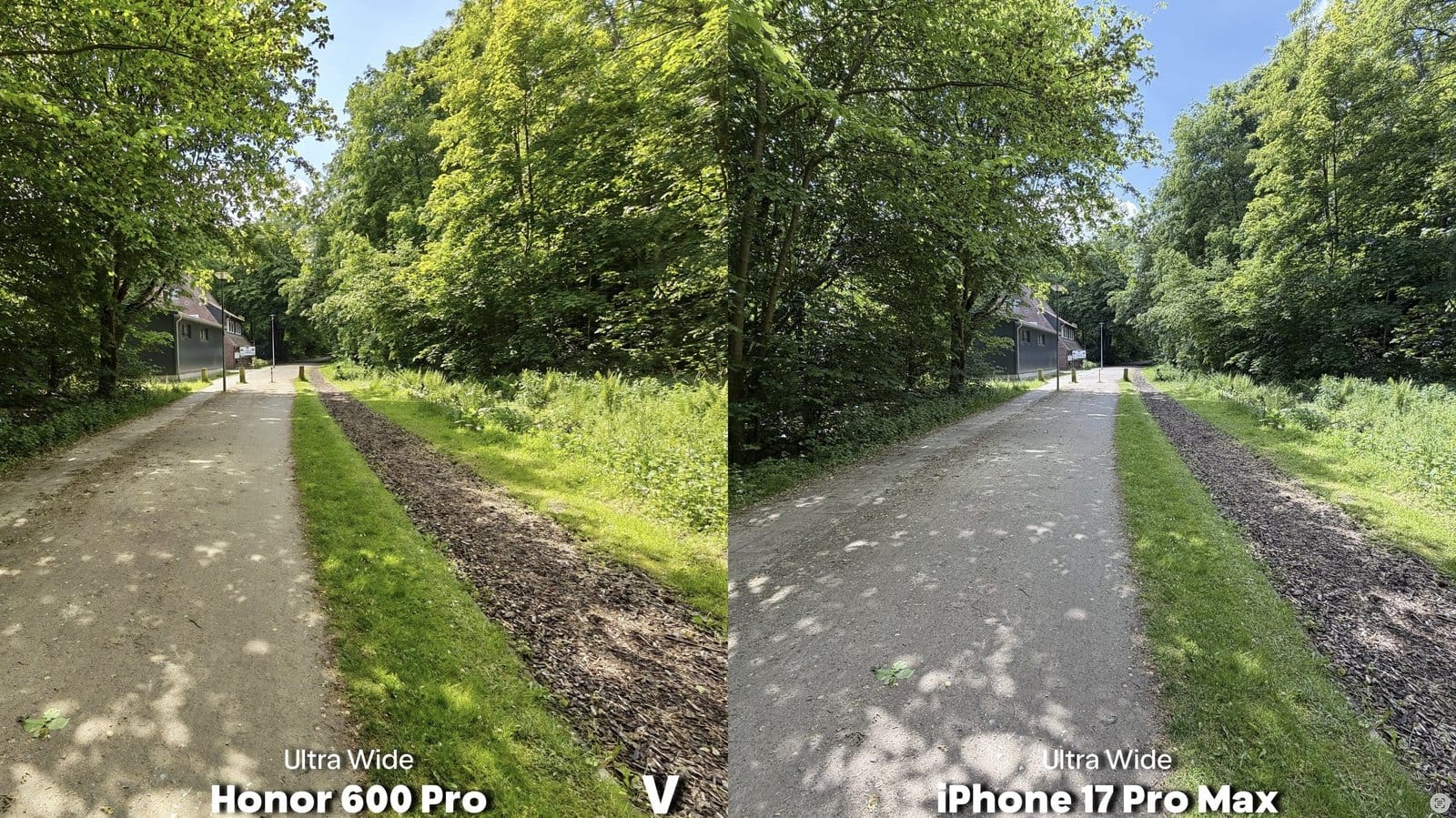
That pattern repeats. In one scene the Honor came out very bright on vibrant, and you can watch the brightness step down with each profile. On the main lens vibrant was again the closest match to the iPhone, and closest to how the scene actually looked in person.
At 2x things split apart. The road surface looks better on vibrant, the greenery is closer on natural, and authentic crushes the blacks. There’s no single style that wins the whole frame.
The iPhone holds a warmer look throughout, which is something iPhones have been known for across several generations.
Zoom, and what the AI enhancer really does
The Honor’s telephoto starts at 3.5x, the iPhone at 4x. In image quality the two lenses are neck and neck, though the natural style introduces a colder tone at 7x.
At 7x and 8x you can bring in Honor’s AI enhancer, but at that range the improvement is marginal. Push further and it becomes a different story. The iPhone tops out at 40x. The Honor goes to 120x.
The real problem is that the enhancer doesn’t just sharpen, it invents. At 40x the enhanced shot has visibly cleaner edges than the iPhone’s, but the signage in the same frame tells the other half of the story: where the iPhone renders blurry but real business names, the Honor produces crisp lettering that spells out something entirely different. In another shot it gave a seagull eyes that weren’t there. At 120x it’s impressive how detailed it makes a car look, right up until you notice the blurred text next to it.

Worth noting: the authentic profile stayed closer to the real thing in a few of these zoom shots, which was the one place it earned its name.
If you’re documenting something, this matters. If you want a shot that looks good on a phone screen, it works well.
Portraits and selfies
Both phones do a fine job with portraits. Shooting vibrant on the Honor gives the more vivid result, and the 2x capture goes to the 600 Pro for looking more refined and detailed. On the telephoto lenses the colours sit close, with skin tones running slightly warmer on the 17 Pro Max. The Honor keeps more of my facial hair unblurred where the iPhone isn’t as clean at that edge. The Honor also shoots portraits up to 7x, and putting both phones’ maximum zoomed portrait side by side, I preferred the Honor.
One issue on Honor’s side: background blur sometimes just doesn’t trigger. It happened often enough to notice.
Selfies go clearly to the iPhone. Both phones offer a wider option, which is the default on the Honor, but the iPhone gives you a wider field of view and handles the whole scene better, especially the colours.
Switching to 1x makes the iPhone look more punched in while the quality still holds up. With portrait mode on the front cameras neither can pull out wider, and the iPhone stays on top for me.

Low light: where the Honor earns its place
On the ultra wide the iPhone is brighter overall, but in quality terms the two are close. That stays true on the main lens, where both do much better than either ultra wide.

At 2x Apple’s brighter output brings noise with it, but it’s more detailed. Move to the telephoto and the Honor shifts toward the iPhone in look and brightness while staying less noisy and more detailed. The 7x shot has an artificial touch, but I’d still take it over Apple’s noisy version.
In one grass scene the Honor came out more detailed and brighter. In another the iPhone’s 2x was too noisy for my liking, and it got worse on the telephoto: you can make out the pattern on the house and the texture of the grass on the Honor, while the 17 Pro Max turns it into a blurry, noisy mess. Neither phone does anything useful at maximum zoom in the dark, but I’d still take the Honor.
The orange light problem
This deserves its own section, because it’s the strangest thing in the whole test.
In an area lit by orange street lights the Honor overdoes the colour, though image quality is clearly superior. Then you switch to the main lens and it filters the orange out almost entirely, which makes the shot look like a completely different scene. The 600 Pro’s version looks really good. It also looks nothing like reality.

At 2x the iPhone takes it back, with enough detail to read some of the text while the colours stay off on the Honor. Switch to the telephoto and the Honor jumps back to the orangey look and takes the better shot, more so at 7x versus 8x.
The same behaviour shows up in low light portraits. The orange gets filtered out, so my skin in an already brighter shot ends up brighter still. The telephoto stops filtering and that shot is clearly better from the 600 Pro, with even 7x holding up. Low light selfies go to the iPhone again, the 600 Pro is just too bright.

Adding the dedicated night mode: the iPhone’s shot is poorer, but the Honor pushes the colours further, most obviously in the sky, and night mode nudges saturation up rather than reining it in. On the main lens it turns the lower third of the frame yellow instead of orange, though the shot is more detailed and night mode does add brightness. At 2x the contrast gets strong on both and the iPhone lands closer to reality.
If you shoot under street lighting a lot, this is the thing to know. It’s not a small colour shift, it’s the phone deciding a light source isn’t there.
Video
Rear cameras at 4K30: the iPhone has the wider field of view on the ultra wide and is more accurate in colour. Look at the floor in the footage and the iPhone has the right tone. Greens on trees and bushes come out too heavily saturated on the 600 Pro. Quality-wise both are fine, but accuracy goes to the iPhone. Honor’s ultra wide video is the weak point, at 4K30 the output looks poor and the jump to the main lens is obvious.
At 60fps there are two real limitations. The front camera drops to 1080p while the iPhone stays at 4K. I ran a poll in my community asking which resolution you prefer to shoot in and most of you said 4K, so that’s a genuine miss. And on the rear cameras at 60fps you can only use the telephoto lens, no ultra wide. The iPhone switches freely between all lenses at any frame rate. To be fair, 4K60 on the rear cameras works fine, so you’re not stuck at 1080p there.
The Honor also has an audio noise reduction tool. I tested it with and without in a quiet forest and by the sea. On most phones this kind of processing sounds a bit artificial to me, and that’s true here too.
Verdict
In daylight the two are much closer than the price difference suggests, which has been the pattern with Honor’s Pro line for a few generations now. Low light is where the 600 Pro genuinely wins, beating the iPhone on the telephoto in scenes where the 17 Pro Max falls apart. Video goes the other way: the iPhone is more colour accurate, has no lens restrictions at 60fps, and shoots 4K on the front camera.
The bigger decision isn’t really about who wins each frame. It’s whether you want a phone that shows you what was there, or one that gives you something punchier straight out of the camera. Everything in this comparison is a trade-off you can live with once you know about it, except one. The orange light behaviour isn’t a preference, it’s the camera removing something that was in front of it.